Saturday, February 17, 2018

Seeking an IT Plan

In our Master's of Leadership cohort are represented four local school districts: Abbotsford, Langley, Surrey, and Coquitlam. It is always interesting when we are given assignments that compare the philosophies and operational practices of each district. While similar in many ways, they are also very different. Just as within a school, the leadership of a district truly affects the growth and health of the staff members - and by extension the students - throughout its entirety.

This past week we were given the assignment, in our Technology for Educational Leaders class, to ferret out our district's technology plan and critique it. Now, I use the word "ferret" quite purposefully, because for all of us, it took a great deal of detective work to find something that should be widely known. Nowhere on the Abbotsford School District website can you find a tech plan. The only indication that something like it should exist is in the Strategic Plan, which - under the heading of Engaging Opportunities - states that one objective is to improve the ethical and innovative use of technology. However, no details for how this is to be achieved are given. One could also infer, given today's learning environments, that the effective use of technology would be embedded in the goal of excellence in teaching, within the Progressive Workforce.


Where is the transparency? We have spent a lot of time learning over the past two years about the importance of professional growth plans, both for ourselves as leaders and for the staff in our buildings. These are meant to be fluid documents, often alluded to, guiding our decisions and practices to ensure we stay focused. I like to think that the same mentality has underscored the building of Abbotsford's Strategic Plan, but while those directly involved in its creation may find it easy to access, the rest of the stakeholders - staff, parents, students - are left largely in the dark.

Thankfully, I know who to ask, so was able to access the Information Technology Centre's document outlining district procedures regarding hardware and software purchases, set-up, and use. In 2016, members of the IT department worked with an outside consultant to determine next steps for the district, including recommendations and projected benefits (such as cost savings, equality of access throughout the district, simplicity of servicing, etc.). I know, from my own observations in schools that many of these recommendations have been adopted and are being enacted. I just didn't expect it to be so difficult to find a public document outlining the plan, its goals, and our progress as a district.

Transparency and accountability are key elements to building trust and community buy-in. Considering the similar difficulty my cohort members from other districts had in tracking down this information, it seems that those elements of transparency and accountability can be a widespread challenge. The learning journey doesn't stop once a person reaches upper management, and as long as every person remains open to feedback from the community, growth and development - at a district, school, and personal level - will always continue.

Saturday, February 3, 2018

Reflecting Teams: Healing Around the Kitchen Table


Conflict-photo.png (499×337)This course has opened our eyes to a variety of theories used in the field of family counseling. While we are not in a counseling program, it's understood that educational leaders are often called upon to mediate conflict within their buildings, whether between staff, students, parents, other admin, or some combination of them all.
What struck me as we examined recent counseling theories was that they all have a systems thinking philosophy at their core. The Bowen Theory, Open Dialogue, and Collaborative Theory are all approaches to conflict resolution that embrace the realization that all parts of a system are connected. Conflict in one area is affected by and will affect the other parts of one's life. Mediators - whether they be trained counselors or educational leaders - need to be aware of this and look for ways to promote healing across environments.  
between_people_together_hands_family_hd-wallpaper-1610760.jpg (1620×1080)Among the various theories we've studied, the concept of Reflecting Teams particularly caught my attention. An idea that began with Tom Andersen in the 1980s, a Reflecting Team, at its most basic, is simply a supportive gathering of loved ones working to resolve a conflict. Andersen envisioned an informal setting, such as the family kitchen table, where family members would gather around to help find solutions. Food and drink help set the informal atmosphere of a family discussion, and help to put people at their ease. 


Founded on the idea that "it takes a village to raise a child," this style of family therapy has those at the centre of the conflict surrounded by friends and supporters. This can be informally around the kitchen table, or more formally in a counseling centre. The facilitator (a more gentle and less intrusive title than counselor), first asks those involved in the conflict to say their piece. The supporters, or Reflecting Team, remain silent and listening. Once those in conflict have stated their concerns, the facilitator asks the Reflecting Team to speak to each other about what they have heard. They are not interacting directly with those at the centre of the conflict, but are instead rephrasing and commenting upon what they heard. As they are friends and family, they will have the ability to shed light on the conflict and offer new perspectives, all while those in conflict listen silently. The facilitator asks pertinent questions, and when the time is right, the spotlight shifts again to those in conflict. Back and forth this process goes, while those present are engaged in listening carefully to the various perspectives, working toward a resolution.

c700x420.jpg (700×420)

As a way to present this form of conflict resolution to our classmates, my group created a kitchen table setting for our peers, complete with soup, biscuits, and tea. While we provided the conflict scenario, our classmates played the role of the Reflecting Team. Sipping on tea and spooning up soup, each member of the class listened to our conflict and, when prompted by the group's facilitator, offered up their thoughts and reflections. Even though our "conflict" was fabricated (albeit based on some recent parent-child conflict I may have experienced!), the feedback from the Reflecting Team was incredibly valuable. It is that feeling of truly being heard that makes this form of conflict resolution so powerful.


Saturday, January 20, 2018

Education Through a Family Systems Lens

We know when we are working with students that the influence we can have in the school is a small part of the larger picture of that child's world. This concept of the elements affecting a child's development have been explored extensively by many theorists, but one of my favourite models is the one put forth by Urie Bronfenbrenner, called the Ecological Systems Theory.

If you Google Bronfenbrenner (especially if you look at images), you'll see variations on the circular model showing nested influences on a child's development.
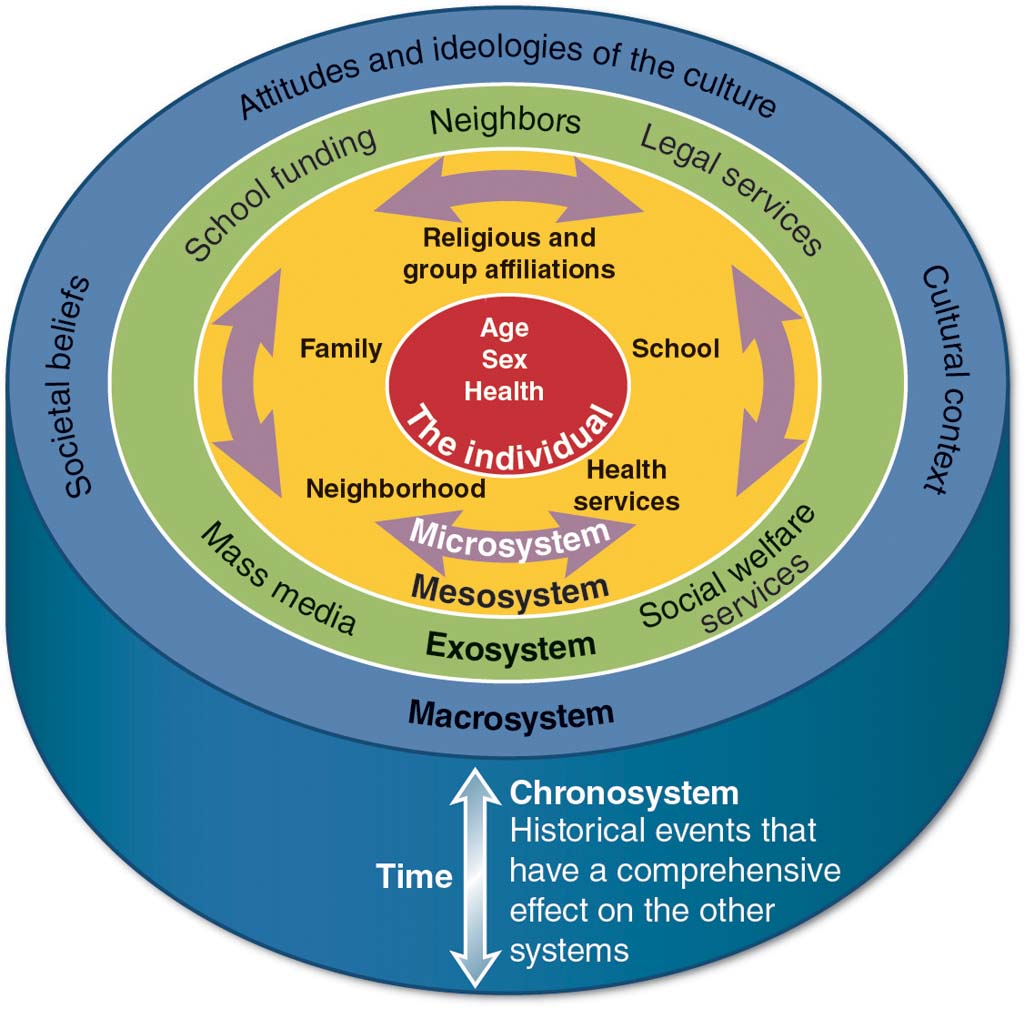

Bronfenbrenner's Ecological Systems Model

At the centre of the model is the child himself, and it is crucial to remember that a child's own genetics play a part in how he will interact with the rest of the layers. All of us have a particular temperament and resultant behaviours that affect how people react to us. A child who is easy-going and compliant will elicit a much different style of parenting - and teachering! - than will a defiant or irritable child. But we know from research (and our own experience) that if we respond to those negative traits with frustration, anger, or an unpredictable combination depending on our current level of patience, those negative behaviours tend to increase - both at home and in the classroom. 

This interaction with parents and teachers - along with siblings, friends, schoolmates - forms the layer closest to the child in Bronfenbrenner's model, which is called the microsystem. This is the most influential level, as this is where meaningful attachments occur which will affect the child throughout life. Kids with secure attachments - based on warmth and love coupled with fair discipline - are at far less risk for future academic and emotional struggles than are those children who have never had the opportunity to develop those secure relationships with those nearest to them. 

I find as a teacher that it is critical for us to be aware of this layer in our daily interactions with kids. We can't change what may or may not be happening in the home, but we have a tremendous ability to be a positive influence for kids in that microsystem layer. Just as there is a lot of research highlighting the importance of secure attachments between parent and child, so too is there a great deal of new research outlining the tremendous benefits to be found in close teacher-child relationships for building resiliency. That's pretty powerful, when we think of the number of kids we interact with everyday! 

A child is a part of several microsystems, such as the home, school, swim club, church group, etc. Bronfenbrenner recognizes that these areas do not exist in a vacuum, and therefore the mesosystem is the layer which explores the interaction of these influences. It is here that we might see the impact on a child's academic success at school from having his parent volunteer in his classroom; the way the social skills a child learns at home impact his relationship with his peers; or the way participation in community sports gives a child newfound confidence on the playground. If we are purposeful as educators, we can work together with families to build opportunities for important life skills to be practiced in multiple environments, making it much more likely that our kids will be able to apply them independently. 

Moving outward in Bronfenbrenner's model, we see some areas of influence on a child's life that are indirect. The exosystem explores those environments that affect the parents, and by extension the child. Parents who have jobs they like, where they feel autonomy and a sense of purpose, are much more likely to be happy and effective as parents (there is research to back this up!). At times of economic recession, such as the one in 2008, there is evidence that parents who have lost their jobs and feel stressed as a result, are more likely to fall into the kind of emotional instability which impacts their ability to be effective parents. Even things like the kinds of friends a child's parents have - and how they spend their time - will have an effect on child development. As educators, we can be a part of this level as well, by recommending helpful community social services to support a family. These don't have a direct impact on the child - he or she is not the one taking language classes, accessing mental health support, or visiting a doctor for chronic pain - but parents who are able to meet their own needs, are far more likely to be able to meet the needs of their kids. 

The macrosystem is one that involves the cultural norms and beliefs that affect the family. An example of this in our Western society would be our propensity toward an individualistic worldview, in which we tend to be focused on our own well-being, with relatively little regard for the larger group around us. We are willing to go out of our way to protect those nearest and dearest to us, but generally consider that people outside that sphere can take care of themselves (again...lots of research to back this up!). In contrast, many other societies have a collectivist culture, in which the family is more naturally supported by the community and the children are cared for by the group as needed. In a society like that, the failure of the group to support a family in need reflects badly on the whole community, so everyone has a strong motivation to keep the whole group healthy. In schools, we can't influence the larger societal norms to any great extent, but we can create a culture that embraces the collectivist ideals. We are a "school family" where every member looks after each other, no matter who they are.

Finally, an element that underpins the ecological model is the chronosystem. This is not a layer, per se, but a consciousness that changes will occur over time both within the child (physical, emotional, and mental development), and within the environment (with family structural changes, residences, historical events, changes in parents' employment, etc.). Each of these changes, large or small, affect the development of the child at some level, and must be considered by those working with the child and his family.

The Bronfenbrenner model resonates with me, as does any theory that recognizes that every area of a child's life affects - and is affected by - the others. We have a critical role as educators, but we severely minimize our potential impact if we don't work alongside parents and the community to enable the whole family system to be in the best shape possible. I strongly feel that this is an area for educational leaders to create change, by focusing on the social, emotional, physical, and academic health of all members of the school community!